



Massive Music Takes the Global Stage at IMPF’s 2025 Conference in Greece
What Does a Music Publisher Do? A Detailed Look at Music Publishing
Summary
A music publisher does more than collect royalties. From documenting and registering musical works to licensing, administration, promotion, and creating new opportunities for songwriters, a publisher helps manage the business side of musical works and supports their commercial use.
What Does a Music Publisher Actually Do?
Once a song has been written, someone needs to make sure the work is properly documented, its rights are administered, opportunities for use can be explored, licenses can be managed, and income generated from the work can be collected and accounted for.
A music publisher represents songwriters and helps manage and monetize their musical works. Depending on the publishing agreement, this can involve creative, business, and administrative responsibilities.
In today's music ecosystem, a song can be used across streaming platforms, social media, advertising, films, series, games, and many other forms of content. Managing the rights and opportunities around those uses is an important part of music publishing.
Music Publisher vs. Record Label
Music publishers and record labels are both important parts of the music industry, but they manage different sides of music.
A music publisher works with rights in the musical composition, with or without lyrics, under an ownership interest or an agreed mandate.
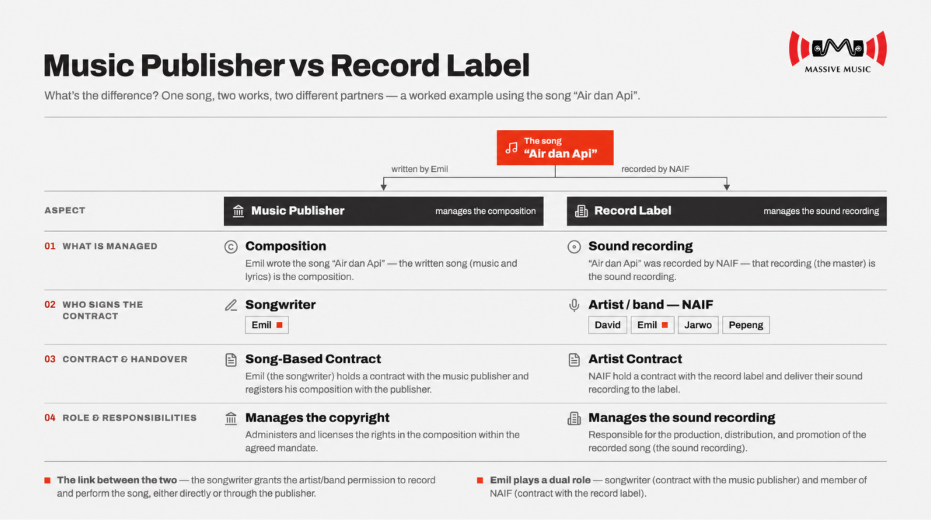
A record label primarily works with sound recordings and their release, distribution and promotion. Whether a label owns a particular master depends on the relevant agreements.
The example shows one composition written by Emil and a recording performed by NAIF. A songwriter can also be a recording artist, but the composition and recording remain separate rights layers. The relevant agreements determine each publisher's and label's authority.
A songwriter writes a song. The rights in that composition must be identified, including any co-writers and existing agreements, before a publisher can manage them.
When an artist records that song, a new sound recording is created. That recording may then be released by a record label.
For example, one song can be performed by Artist A and released by Label A, while another version of the same composition is performed by Artist B and released by Label B.
This distinction is important for songwriters because having a song released by a label does not automatically mean the songwriter's publishing rights are being managed by that label. The two sides can involve different parties and different rights.
Music Publisher vs. Music Aggregator
A music publisher and a music aggregator can also be involved in the journey of the same song, but their functions are different.
A music aggregator primarily helps distribute recordings to digital platforms, making music available across services such as streaming platforms.
A music publisher manages and administers rights in the underlying musical composition.
Aggregator → helps distribute the recording.
Music Publisher → administers rights in the composition within its mandate.
1. Register and Document Musical Works
One of the basic responsibilities of music publishing is making sure musical works are properly documented.
A musical work may involve one songwriter or several songwriters, each with their respective ownership or songwriter share. Accurate information about the work and its creators is therefore important for rights administration and royalty collection.
Within its mandate, a publisher may submit work information to relevant rights-management systems and maintain the records needed for administration. The systems and responsibilities depend on the rights and territory.
This may include information about the title, creators, ownership shares, and other details needed to identify and administer the work.
Accurate records help identify works across platforms and territories. Registering a work for publishing administration is separate from the creation of copyright and from government recordation.
2. Administer Rights Within the Agreed Scope
A music publisher manages and administers the rights connected to musical works within the scope of its agreement with the songwriter.
This can include maintaining registrations, managing rights information, monitoring uses, and handling administrative processes connected to the catalogue.
3. Pitch and Promote Musical Works
Publishers can pitch and promote their songwriters' musical works to potential users and creative partners, including artists, record labels, producers, advertising agencies, and other parts of the entertainment industry.
For example, a publisher may pitch a musical work written by one songwriter to an artist looking for a song to record.
If the artist chooses to record the work and the required permissions are secured, the songwriter may receive agreed income and credit. A pitch does not guarantee a recording, placement or payment.
4. Create Opportunities for Songwriters
Publishers may arrange co-writes, introduce songwriters to other creators, and connect them with artists, producers, labels, or other potential collaborators.
5. Find and Manage Licensing Opportunities
Musical works can be used in many different types of content and commercial activities.
Publishers can help identify and manage licensing opportunities for uses such as:
- Films
- TV shows
- Commercials
- Digital video
- Streaming platforms
- Games and applications
- Other entertainment and commercial uses
When a music user wants to use a musical work, the publisher may offer the relevant catalogue, communicate with the potential user, negotiate the terms, and manage the necessary licensing documentation within its authority.
The specific licensing authority depends on the rights represented and the terms of the publishing agreement.
6. Handle Licensing Administration
This can include preparing or managing agreements, recording the relevant usage information, and maintaining documentation connected to the license.
7. Track and Collect Royalties
When a musical work generates income, someone needs to make sure that the income can be properly identified, collected, and accounted for.
A publisher can administer royalty collection from different sources, including digital platforms and licensed uses of musical works.
This can involve receiving usage information, processing royalty statements, and accounting for the income generated by the works within the scope of the publishing agreement.
For songwriters who manage their own publishing, these responsibilities remain with them. Working with a publisher means these activities can be handled by a dedicated publishing partner, according to the agreed scope.
8. Work with Different Parts of the Music Ecosystem
Publishers can work with:
- Songwriters
- Record labels
- Music producers
- Artists
- Rights-management organizations, where relevant to the mandate
- Streaming platforms
- Film and TV studios
- Advertising agencies
- Other music and entertainment businesses
These relationships can serve different purposes, from rights administration and royalty collection to creative collaboration and licensing.
More Than Managing Royalties
Before signing, confirm the services, works, shares, rights, territory, term, reporting and income arrangements the publishing agreement covers.
The practical question is which responsibilities the publisher will take on, and how those responsibilities will be documented and reported.
Want to Know More About Music Publishing?
Explore Songwriter Overview. Prepare your questions about rights, catalogue scope, reporting and the agreement before starting a publishing relationship.
References
Indonesian Copyright Law — Articles 1, 9, 64 and 80